Our Favorite Colors

Recently we celebrated a milestone on Instagram by offering insight into our favorite LBI paint colors. For every project we curate a specific color palette, but these are the tried and true colors that have succeeded for us time after time. If you like the vibe of our interiors, you’ll be happy to have insight into these ‘go-to’ colors.

Here are the color categories, along with descriptions, examples, and a few cautions mixed in.

Clean Whites: Sherwin Williams Pure White, Benjamin Moore Decorator’s White, Benjamin Moore Simply White.

These whites are white in its purist form. They don’t have yellow or gray undertones, so they read crisp and clean. When selecting whites, pay attention to countertops, sinks, and other ‘white’ materials in the space that could become yellow in comparison.

Benjamin Moore Simply White sets the foundation for walls, trim, and ceilings in this home, so that the client’s art collection can take center stage (artwork by Mallory Page, photo by An Indoor Lady)

Benjamin Moore Simply White sets the foundation for walls, trim, and ceilings in this home, so that the client’s art collection can take center stage (artwork by Mallory Page, photo by An Indoor Lady)

Soft Warm Whites: Sherwin Williams Greek Villa, Benjamin Moore White Dove, Benjamin Moore Intense White

These whites are less “crisp” and more “soft”. They lean warm and can work well with palettes that include organic natural materials.

The sheetrock walls in this home are painted Benjamin Moore Intense White. It works well with the smooth Lueders Limestone walls and the travertine floors. (Photo by An Indoor Lady)

The sheetrock walls in this home are painted Benjamin Moore Intense White. It works well with the smooth Lueders Limestone walls and the travertine floors. (Photo by An Indoor Lady)

Cool Whites with Gray undertones: Sherwin Williams Drift of Mist, Sherwin Williams Pearly White

These colors are essentially the opposite of “warm white”. With too much warmth next to gray tones, a warm white would look yellow and dingy, so these whites offer that balance of soft but cool.

Since the white in this exterior scheme was side by side with gray siding, we used Sherwin Williams Drift of Mist to keep it soft yet fresh, avoiding the risk of a yellow tint. (Photo by Chase Daniel)

Since the white in this exterior scheme was side by side with gray siding, we used Sherwin Williams Drift of Mist to keep it soft yet fresh, avoiding the risk of a yellow tint. (Photo by Chase Daniel)

Soft Neutral Gray: Sherwin Williams Skyline Steel, Sherwin Williams Worldly Gray, Sherwin Williams Repose Gray

For spaces where the vibe is neutral but not white , these colors offer a nice balance. The trends in design have gone gray in recent years, but at LBI we are intentionally rooted in timeless design, so when going gray we lean toward warmth and tones that work well with organic textures.

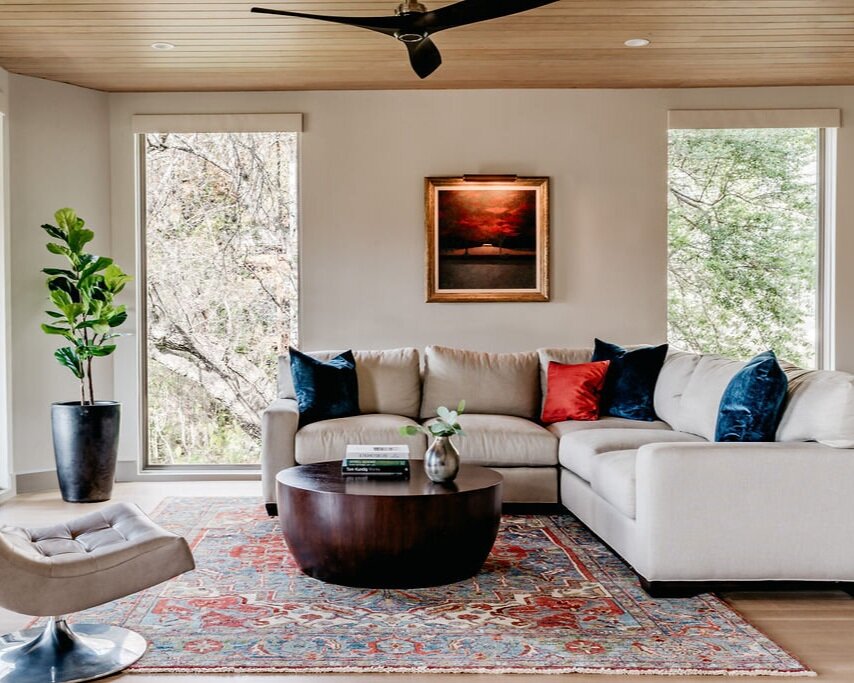
This Repose Gray living room has leather and brass, a gold-toned rug, and fabulous views of the outdoors. Fun fact - the sculpture in the corner is a Remington. Pretty cool! (Photo by David Duncan Livingston)

This Repose Gray living room has leather and brass, a gold-toned rug, and fabulous views of the outdoors. Fun fact - the sculpture in the corner is a Remington. Pretty cool! (Photo by David Duncan Livingston)

Charcoal Gray: Sherwin Williams Grizzle Gray, Sherwin Williams Rock Bottom, Benjamin Moore Kendall Charcoal

We love creating a masculine interior with layers of texture and deep moody colors. Charcoal Gray looks great on cabinets and walls, and feels a little less intense than off-black or black.

These Sherwin Williams Rock Bottom walls create a nice richness with the custom walnut bed and nightstands. (photography via my iPhone. Can you tell?)

These Sherwin Williams Rock Bottom walls create a nice richness with the custom walnut bed and nightstands. (photography via my iPhone. Can you tell?)

Off Black: Sherwin Williams Iron Ore, Benjamin Moore Iron Mountain, Benjamin Moore Dragon’s Breath

Sometimes we need a black that doesn’t feel as harsh as black. That’s when we opt for OFF black. Pay attention to the undertones, they can sometimes lean blue-gray or green-gray. That might be okay, but be careful what you put them next to.

This powder room has a Sherwin Williams Iron Ore cabinet, walls, ceilings, and trim. We wanted it to feel rich and moody. Something cool about this Powder - it was the first install of our very own Finery Hardware! It holds a special place in our he…

This powder room has a Sherwin Williams Iron Ore cabinet, walls, ceilings, and trim. We wanted it to feel rich and moody. Something cool about this Powder - it was the first install of our very own Finery Hardware! It holds a special place in our hearts. (Photo by An Indoor Lady)

True Black: Sherwin Williams Tricorn, Sherwin Williams Black Magic, Sherwin Williams Inkwell

Sometimes there is just no substitute for Black. You need that contrast and pop. These colors are great for that.

The Sherwin Williams Black Magic fascia in this photo does a nice job accentuating the charcoal gray roof and tying it back to the black steel windows and doors.

The Sherwin Williams Black Magic fascia in this photo does a nice job accentuating the charcoal gray roof and tying it back to the black steel windows and doors.

Deep Blues & Greens: Sherwin Williams Gale Force, Sherwin Williams Naval, Sherwin Williams Cast Iron, Sherwin Williams Jasper, Benjamin Moore Polo

We love these colors for cabinets and molding when a touch of color feels right. These are deeper, masculine blues and greens, so they wouldn’t be described as “colorful”, but they add interest.
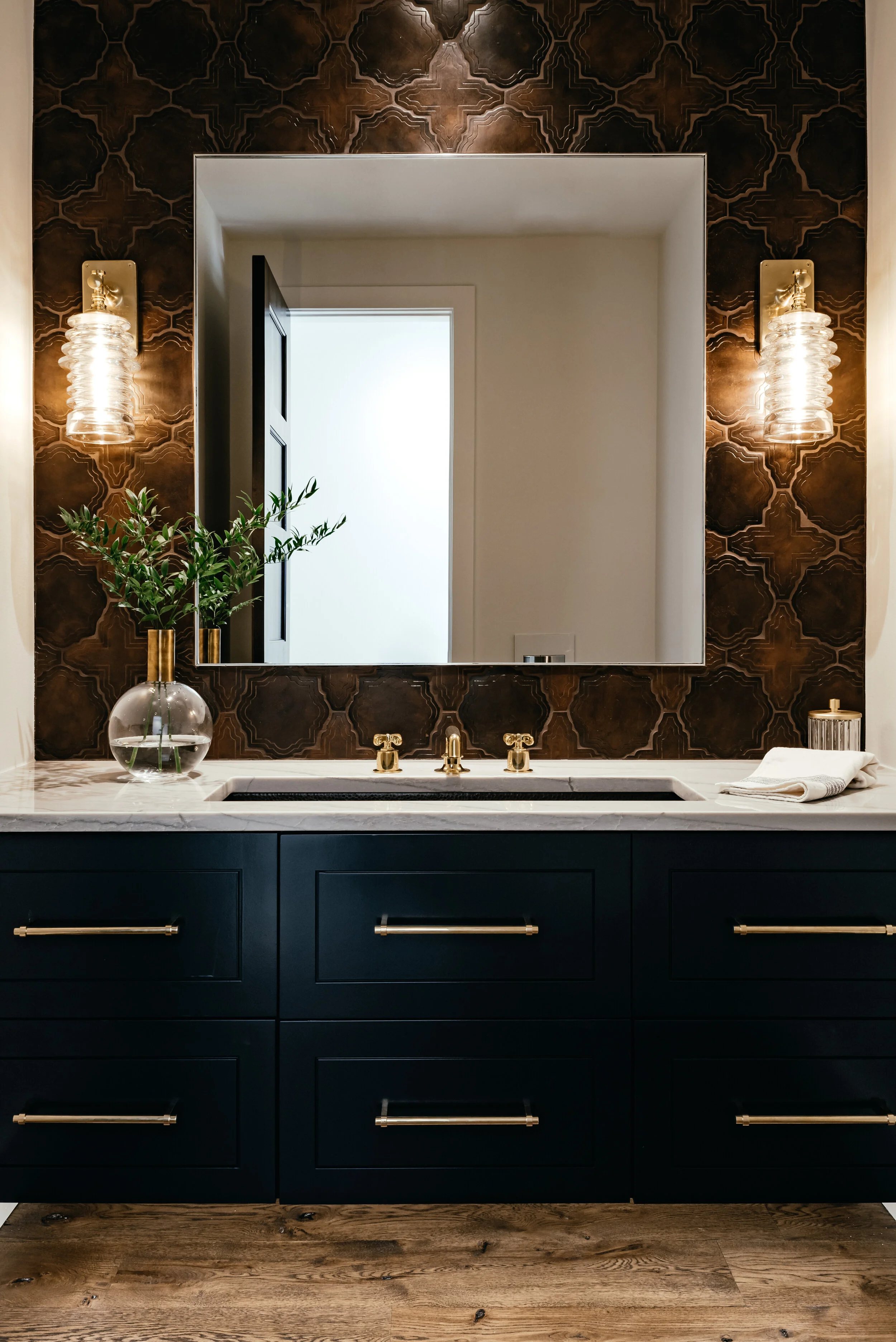
This Benjamin Moore Polo is the perfect cabinet accent in a rich and textural powder. The navy is classic, but the application is contemporary. One of our favorites! (Photo by An Indoor Lady)

This Benjamin Moore Polo is the perfect cabinet accent in a rich and textural powder. The navy is classic, but the application is contemporary. One of our favorites! (Photo by An Indoor Lady)

We hope you’ll enjoy playing with these! For most conditions you’ll want to review samples, because color involves a relationship with other materials in the scheme (stone, brick, tile, etc.) as well as with the lighting, but hopefully this gives you a good place to start!
The Art of Coordinating Wood Finishes

I know it’s time for a blog post when an issue pops up repeatedly in the course of a few weeks. The topic for today? Coordinating wood finishes

Wood tones are complicated for many reasons, and coordinating can be challenging for those who haven’t experimented and learned lessons along the way. Recently I’ve had clients wanting to embrace more natural wood tones, which makes it especially tricky when mixing species. Here are some things to know.

THE PROBLEM

Wood species (i.e. types of trees) have different characteristics and price points that makes each of them best suited for specific functions. Unfortunately, they don’t all take stains in the same way, so having them coordinate well in a space takes planning and intentionality. Even if you try to use the same stain on everything, it will have different results on various wood surfaces. You should also consider the grade of wood, from knotty, to mixed grain or clear grades of lumber, and make sure they are suited for the style of your home.

QUALITIES OF COMMON CONSTRUCTION WOOD TYPES

Pine – Benefits: It is strong and economical, which makes it great for structural lumber. Drawback: it has a predominant yellow/ orange tone with heavy grain and frequent knots. It is a common soft wood that requires special care and treatment if used outdoors, and the grain pattern make it best suited for rustic or farmhouse styles. It is most commonly used for structural tasks that won’t be visible (for example 2x4s used in framing), and beware - it is also frequently milled for tongue and groove siding (probably because of the price), so if your builder uses it and you intend to stain it, you’ll have limited color choices. Plan to take special care if it’s used outside.

Fir Benefits: Fir is also strong, less yellow, and generally less knotty than Pine. Fir is a good option to specify for stain grade trim and exposed structural wood if the project budget can support higher grade grain patterns. It is typically used for long structural components such as beams and trusses because the trees are tall. Drawback: Stains can easily go dark, but it is hard to stain light. If a client has inspiration pictures with light stained beams, I specify Oak beams (which are expensive, so we discuss it first) or an Oak wrapped ‘box beam’ which is not a solid beam, but can achieve the desired look.

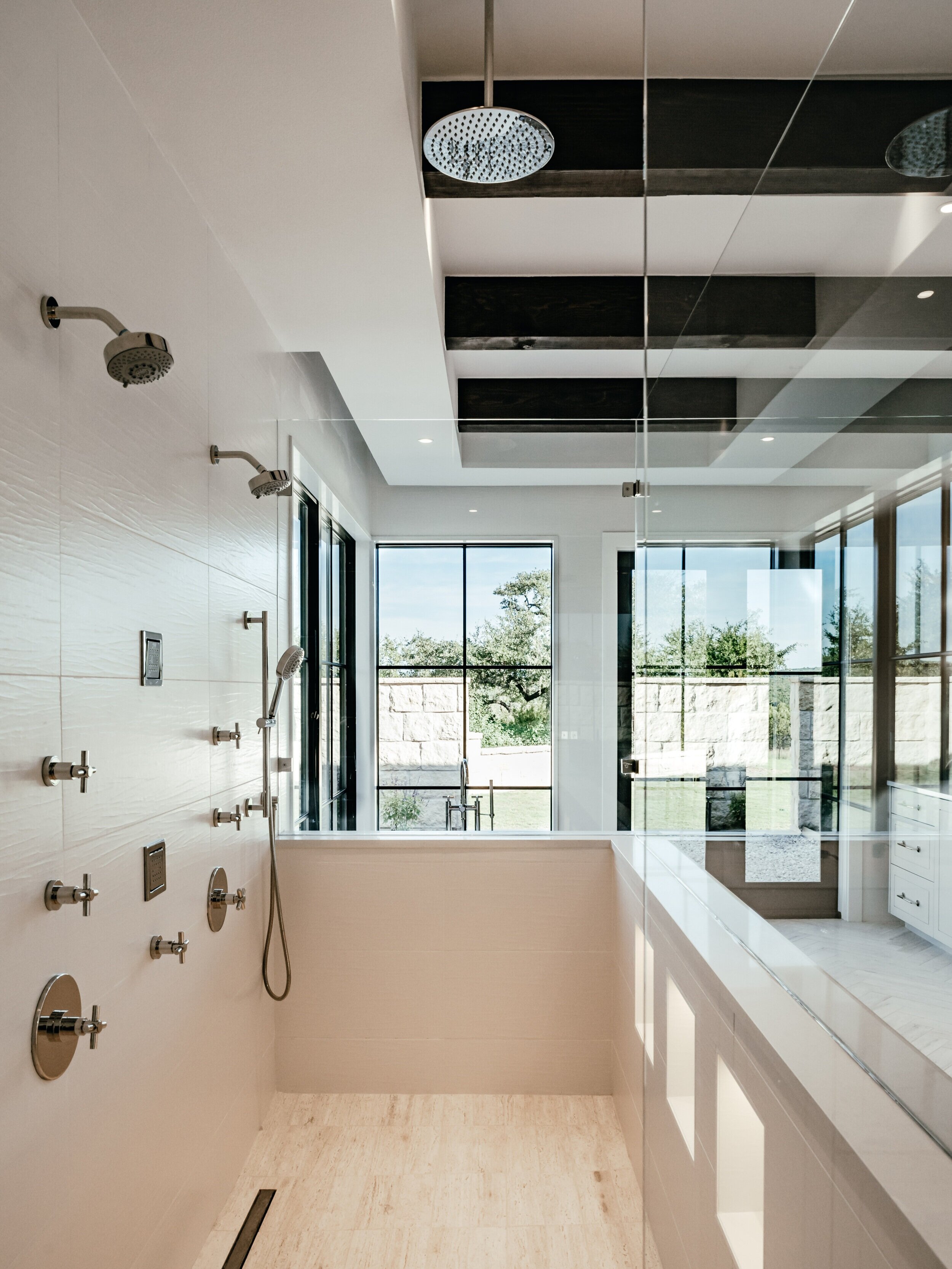
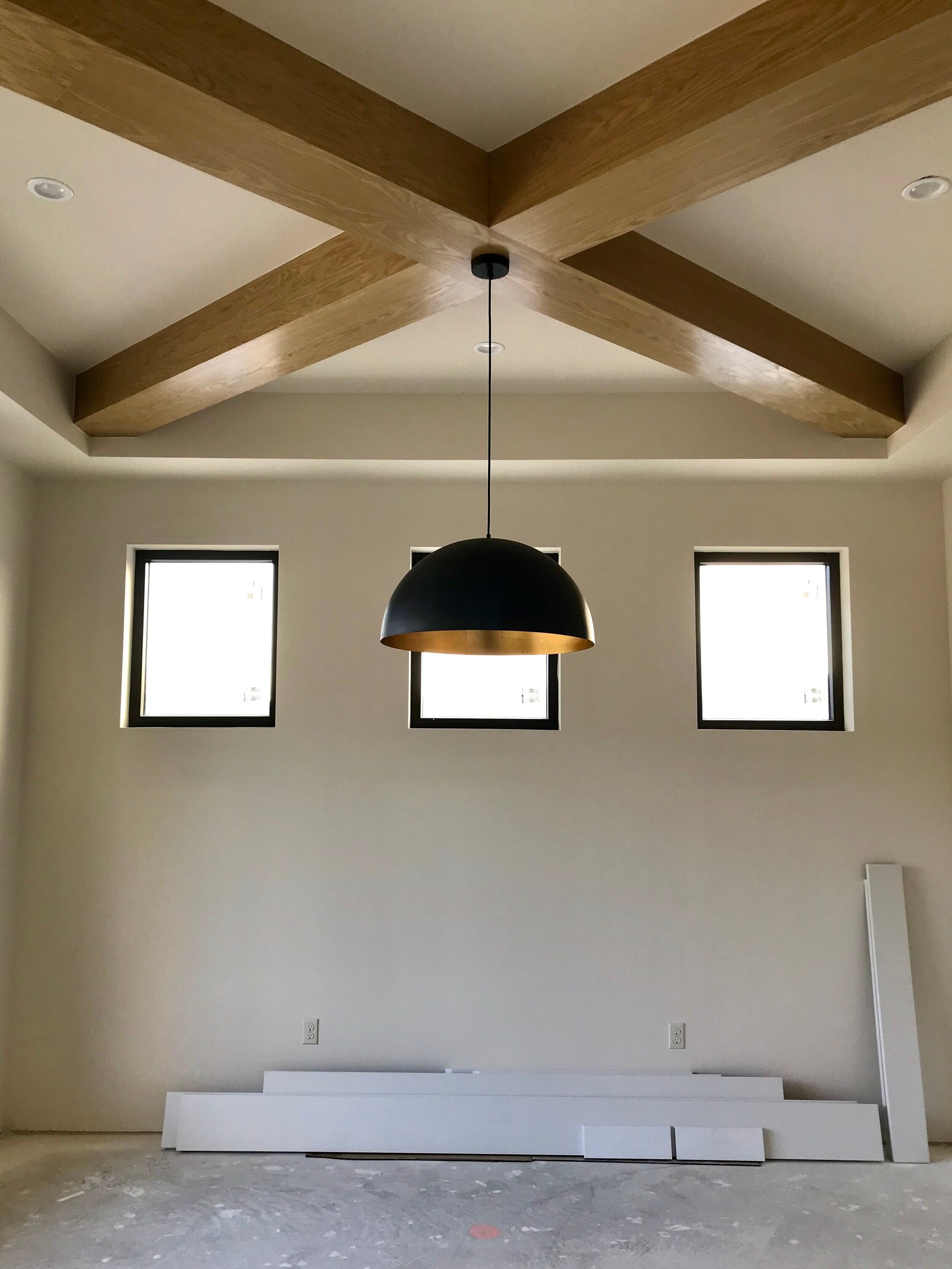
Above Left: These dark beams show a standard stain color that was easy to achieve with Fir. Photo by An Indoor Lady. Above Right: This is an Oak wrapped box beam, created that way to achieve a light stain color.

Cedar – Benefits: Cedar has a fine grain and is really stable. It holds up well outside without rotting (which is why you’ll see it often as exterior siding) and it even has a natural moth resistant quality, which is why you’ll see it in closets and furniture chests. Cedar can be a great choice for many styles of architecture depending on the specified grade, milling pattern, and finish. Drawback: Beware on color tone – the true color is a rich orange that is beautiful if you embrace it, but it is hard to take it other directions. Clients are often tempted to leave it the lighter tone of it’s unsealed state, but that color won’t last in the long term. Once sealed, it becomes orange without fail. 

Both of these pictures are examples of natural sealed Cedar siding. Photos by An Indoor Lady.


Oak – there are 2 kinds: Red Oak and White Oak (my personal favorite). Benefits: There are many in my opinion. Oak is a hard and durable wood and is well suited for many construction uses (most frequently flooring and cabinets). What I love about it is the color flexibility. It is gorgeous left in a natural sealed state, and it can be taken in many subtle tonal directions. Drawbacks? The price-point is high, and for that reason it is often a “special order” item for some components.


Both of these LBI kitchens use White Oak for both floors and cabinets. Photos by An Indoor Lady.

Those are just a few examples, but there are many more species and layers of things to consider, such as milling profiles, grain direction, bla bla bla. Without going into all of those details, I am going to boil it down to some key suggestions:

TIPS

1)    Determine if the wood grain and tones in your space are a key element to the design. Pay special attention to flooring, ceilings, cabinets, and exposed structural elements related to your vision. Especially if the tones are light and your design is refined, it’s important for you to be intentional from the beginning.

2)    Make sure that your Architect, Builder, and Designer all know that the wood quality and durability is important to you. Check that it is specified and budgeted accordingly. All too often homeowners are unaware of the nuances and leave this to chance. In the absence of a plan and careful thought to the wood products for a project, it is unlikely that all materials will coordinate. Upgrading them comes at a price, and the higher-grade materials cost what they cost. If it appears that some of your project bids are much lower than others, make sure what they have planned for this category is what you want.

3)    Start early with experimenting and sampling stains on the exact material you plan to use. This is a process. Allow plenty of time so the decision does not become stressful and hold up the construction process.

4)    For T&G siding (ceilings, soffits, wall surfaces) – pay special attention to the milling profile, which should match the architectural style of your house. V-groove is common but used in more rustic settings, whereas for contemporary homes you might choose a butt-joint or nickel gap.  The milling pattern should be specified to match the architectural style of the house. 

INSIDER INFO

My personal favorite wood for flexibility is White Oak. Most building components (cabinets, floors, beams, etc.) can be purchased as White Oak, but it is frequently the expensive choice. After years of experimentation I have found stain formulas for various species that can coordinate with Oak (many of our clients use it for floors), and so I am intentional about what I ask for if I am doing the specifications. While I mentioned just a few common ones, we use many other woods not even mentioned in this short article (for example, I love walnut for furniture, but you won’t usually see it as a choice in structural lumber).

In these projects we asked for specific T&G ceiling material that we could coordinate with the Oak floors. Above Left: A Hemlock ceiling. Above Right: A Clear Alder ceiling. Photo by An Indoor Lady.

MORAL OF THE STORY

Pay attention and plan ahead. All of these products have their place in the construction or renovation of a residence, but make sure thought is giving to using the products where they are best suited; specifying grades, milling, and finishes to match the style of your project. Talk to you project team and ask questions about what has been planned and budgeted. Not interested in researching and understanding all of these details? I get it. Find an industry professional whom you trust, and let them guide you along the way.

Ideas for Your Place, while Sheltering in Place

Photo courtesy of @southcongresscottage

Photo courtesy of @southcongresscottage

Hi everyone! To help us all avoid “Sheltering in Place” depression, I decided to offer something productive. Here is a blog post to hopefully inspire you with home ideas while you’re stuck there. Enjoy!

1.     Give your space a springtime facelift. Look at your throw blankets, pillows, bedding - freshen up the colors & textures for warmer weather. Put some greenery from the yard in a vase! I’ve taken this time at home to spruce up my deck and put seed in the bird feeders.

2.     Speaking of feeling fresh for spring: now is a good time to wash slipcovers, pillow covers, and rugs. I for one have items that get dingy where our dog likes to lounge.

3.     Organize. I’ve had several clients & friends tell me they’re taking advantage of this extra time to organize their closets, home office, pantry - you name it! First on MY list is our Guest Bedroom. It is currently over-run by gift bags.

4.     Rearrange your furniture. I used to do this to my bedroom all the time as a child. It’s a chance to get rid of dust-bunnies & it will give you a fresh perspective.

5.     If you have kids at home, create child art. Kids are absolutely the best artists! Give them paint & let them go to town. If there’s an area where you need color - point them in the right direction, then frame it!

6.     Re-arrange a vignette area (coffee table, book shelf, sofa table, etc.). Swap out what’s there for new books, a framed picture or two, maybe a candle. These areas can get tired and stale if you don’t revisit them every now and then.

7.     Speaking of candles, light your favorite one. Just for you. Yep, no one else. Just you.

And lastly, stay connected with loved ones and friends. This experience can feel isolating. I tend to enjoy my alone time, but even I’m getting pangs of cabin fever. We’ll get through it if we all stick together (yes, 6’ apart, but TOGETHER)!